
|
Heads
Up
The
Aviation Safety Reporting System receives approximately 3,000
reports each month. The subject matter of these reports runs
the gamut from predictable regulars, such as runway
incursions and altitude busts to noteworthy new issues
that may generate specific ASRS actions to help the industry
resolve the issues.
From
time to time we note an increase of reports discussing these
routine, but important tasks or actions; they often become
quite visible when those performing them become less cautious
in performing them and unexpected operational errors result.
This
issue of CALLBACK will provide a Heads Up regarding
a few such recurring issues. Our hope is that reading about
them will refresh your memory, and reduce the likelihood of
an error.
A
second type of Heads Up we'll discuss in this
issue will illuminate NEW, but
potentialy critical issues that have come to our attention
often as a result of receiving large numbers of reports
on a single issue in a short time period.
Pilot/Controller
Heads Up!
Altimeter Errors
Every
winter, areas of low pressure develop as storm systems move
across the country. The low pressure areas and associated
weather are predicted by meteorologists, tracked real-time
by weather radar, and confirmed after the fact by increases
in ASRS reports dealing with altitude overshoots, undershoots,
and missed crossing restrictions. Winter weather will be
around for a while yet. Heads up! Be alert for unusually
low altimeter settings.
-
The
aircraft was prepared for departure from [a non-towered
airport] with no weather reporting. I thought the altimeter
was set to field elevation of 710 feet. Several checks
of the altimeter were made before departure. I felt the
climb to cruise altitude of 2,500 feet was taking longer
than normal even though the rate of climb was very good.
After leveling off at 2,500 feet, I felt like I was higher
than normal. The ASOS (Automated Surface Observing System)
frequency was checked about 12 miles from destination
and a minor altimeter setting adjustment was made in accordance
with that report. I started a descent to pattern altitude
(1,600 feet) about nine miles out and transmitted my position
and intentions on the UNICOM frequency. The UNICOM operator
reported winds and altimeter setting which were acknowledged.
Once again, during descent, I felt that the aircraft was
higher than normal. It wasn't until I turned downwind
that I finally realized that the altimeter had inadvertently
been set to 29.70 inches instead of 30.74 inches. When
initially setting the altimeter, I only moved the setting
a slight amount to get the needle to indicate the field
elevation. I never noticed that the 1,000 foot needle
was below 0 feet. The last time the aircraft was flown
was six days earlier when there was a low pressure system
in the area.
-
On
descent we were given an altimeter setting of 29.34 inches.
Because it was so low, I double checked with ATIS and
found that it was correct. Going through 18,000 feet,
I called and set 29.34 on both altimeters on my side and
cross-checked the First Officer's side. Apparently, I
only checked the last two digits. I did not realize that
his was set at 30.34. Since that produced a difference
of 1,000 feet, I did not recognize the discrepancy when
the dials were winding down in tandem. As 10
started showing on my altimeter digital readout, I realized
that something was amiss. The First Officer immediately
stopped the descent, reset, and leveled at 11,000 feet.
We missed our altitude by about 500 feet... I was making
an announcement to the cabin when the 1,000 feet
to go call should have been made. A very experienced
flight crew made an error that 99 out of 100 times would
have been caught. It gave me a wake up call.
Flight
Attendant Heads
Up! Cabin Doors
Sometimes
there is no readily apparent reason for an influx of reports
dealing with a particular issue. It may simply be that enough
time has passed since there was widespread discussion or
increased emphasis on the matter and people have grown complacent.
Whatever the reason, there has been a recent surge in flight
attendant reports which deal with arming and disarming cabin
doors. Heads up! Check and cross-check.
-
I
failed to arm the 1R door for departure. The [inbound
aircraft, a B767-300] was about two and one-half hours
delayed. I felt rushed to get the galley in first class
set up. I didn't hear the command to arm the doors for
departure. Because it was going to be bumpy during the
climb, we were told to remain seated. When we reached
altitude, the Captain called the Purser to notify her
that a warning light indicated that door 1R was not closed
properly. We looked at the door and then realized that
it was not armed. We tried arming the door, but couldn't.
The Captain then descended and proceeded to burn fuel
for a landing back at [departure airport]. Mechanics determined
that the door was not closed properly...
-
The
1L and 1R doors in first class [of our B757-200] were
not disarmed after the announcement was made. I checked
doors 3 and 4 and they were disarmed. I was on my way
to the first class compartment when I was interrupted
by a passenger. With the distraction, I forgot to check
whether 1L and 1R were disarmed.
-
I
failed to disarm door 1R on a B737. Fortunately, the purser
found the door armed and disarmed it. These B737's have
no armed indicator on the outside of the aircraft or in
the cockpit. They are very dangerous for anyone trying
to enter the aircraft from the outside. Everyone needs
to understand how important it is to disarm, check, and
cross-check. These doors are not always easy to arm and
disarm. When working long hours, we're tired and really
need to pay special attention to this responsibility.
Check and cross-check!
Pilot/Controller
Heads Up! Similar Callsigns
Errors
resulting from similar sounding callsigns present another
example of a chronic issue in which report volume may correspond
to the amount of attention given to the problem.
The
following two reports, typical of several recent callsign
confusion incidents, are an indication that pilots
and controllers need to renew their awareness of this problem.
Heads up! Listen up!
-
We...
were on an arrival in IMC. We had changed frequencies
and were told to descend to 9,000 feet... The controller
vectored us to a heading of 130 degrees for sequencing.
The controller told flight ABCD, Descend to 7,000
feet. We had not been told of any similar flight
numbers being on the frequency and called to confirm that
it was, Flight AECD down to 7,000 feet, but
did not get a response and assumed it was due to the controller's
workload. We reached 7,000 feet and were following vectors.
The controller then gave approach instructions to flight
ABCD. Before we could respond to correct the controller
that our flight number was, in fact, AECD, flight ABCD
accepted the instructions to join the approach to Runway
4. As soon as we realized the error, we contacted approach
and notified them of our altitude and began to climb back
to 9,000 feet... The controller instructed us to return
to 7000 feet... We were handed off to two more frequencies
before a controller notified us that we were following
our company flight ABCD and to be aware of similar callsigns.
-
Our
crew was flying air carrier X flight from
ZZZ to YYY. We were 40 miles southeast of the VOR in an
area where numerous air carrier flights were crossing.
We thought we heard the controller tell us to descend
to 14,000 feet from 15,000 feet. As we were leveling at
14,000 feet, the controller called out traffic to us at
our one and two o'clock positions, at 14,000 feet. We
saw and reported the traffic to him. ATC then asked us
what altitude we were at. We responded, 14,000 feet.
ATC told us we shouldn't be at 14,000 feet; that we took
air carrier Y's altitude clearance. The controller
then told us to climb back to 15,000 feet and remain clear
of traffic. Our TCASII sounded and we climbed immediately...
We did not listen clearly to the clearance for a similar
sounding callsign. ATC was busy with numerous calls and
didn't realize we took another aircraft's clearance until
a potential conflict occurred. I apologized to the controller
when we leveled off at 15,000 feet. No feelings were hurt.
No metal was bent, and I learned a valuable lesson; Listen
up!
Pilot/Controller
Heads Up!
DFW RNAV Departure
To
date, over sixty reports have been submitted to ASRS regarding
deviations from the Dallas-Fort Worth (DFW) RNAV Standard
Instrument Departures (SIDs). The following report highlights
the problem most frequently cited, specifically, a track
deviation from a transition portion of the SID.
-
While
climbing through approximately 25,000 feet on the TRISS2
RNAV departure, ATC called and asked where were we going.
The First Officer responded that we were, Direct
TXK, since that was the next active waypoint. ATC
asked if we were on the departure and we replied that
we were on the TRISS2 however, the previous controller
had given us a shortcut direct TRISS. ATC advised that
we had missed the SHERO waypoint and went on to say that,
although there was no traffic conflict, it did appear
to be a pilot deviation. We examined the FMS Legs page
and noted that for some unknown reason, SHERO was no longer
stored on the FMS flight plan. After TRISS we should have
tracked to SHERO, but did not. The controller was correct
and I believe we were about 3-4 miles north of course.
The question is, why did SHERO disappear from the FMS
flight plan?
ASRS
examination of many reports similar to the above
occurring on DFW RNAV SIDs has illuminated several
recurring factors. The majority of the reported track
deviations occurred on the TRANSITION portion of the RNAV
SID procedure. Review of the reports indicates one of two
things likely happened. Either the TRANSITION was never
installed during FMC programming, or some ATC initiated
modification, such as a departure runway change, resulted
in the transition waypoints being eliminated.
Pilots
should be aware that three distinct departure elements must
be line selected from the FMS Dep/Arr Page when programming
the FMS for every RNAV SID from DFW. First, the assigned
Runway must be line selected; second, the Cleared
SID must be line selected and; third, the associated TRANSITION
must be line selected. Note that every SID requires all
three elements: Assigned Runway, the SID, and the appropriate
TRANSITION.
If,
at any time, any ATC directed modification is made
to any of these three essential elements, the FMS
Legs page must be reviewed to ensure all waypoints
have been retained or appropriately modified.
Finally,
users of an ACARS PDC must be aware that the format for
the printed clearance may not display the transition in
the same manner it is shown on the departure plate, i.e.,
a clearance via the TRISS 2 departure TEXARKANA TRANSITION
may be printed: TRISS2 (space) TXK, not: TRISS2.(dot)TXK
as shown on the departure plate itself. This must not
be interpreted as direct to TXK after TRISS but, properly,
as a clearance to fly the TXK TRANSITION.
Meet
the Staff
Jorge
Moya
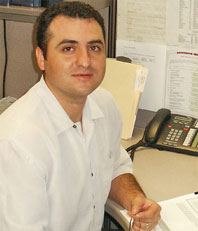
 |
Jorge
Moya joined the ASRS staff as an Assistant Analyst
in 2000 while attending San Jose State University.
After graduating in 2002 with a B.S. in Aviation Operations
and minors in Business Management and Spanish, Jorge
became an ASRS Researcher and Alert Distribution Coordinator.
Jorge
conducts ASRS database searches for government and
private entities, tabulates research data, and coordinates
publication of related materials. Jorge is also a
vital link in the timely dissemination of ASRS Safety
Alert Bulletins.
When
he's not crunching data in the office, Jorge can be
found tramping over the local golf links where he
plays to a ten handicap.
|
|
| ASRS
Alerts Issued in January 2006 |
|
Subject
of Alert
|
No.
of Alerts |
|
Aircraft
or aircraft equipment
|
7 |
|
Airport
facility or procedure
|
5 |
|
ATC
procedure or equipment
|
3 |
|
Chart
or publication
|
1 |
|
TOTAL
|
16 |
|
|
|
January 2006 Report Intake
|
| Air
Carrier/Air Taxi Pilots |
2,209
|
| General
Aviation Pilots |
661
|
| Controllers |
76
|
| Cabin/Mechanics/Military/Other |
268
|
| TOTAL |
3,214
|
|
|