 |
||||||
|
|
Number
309
|
June
2005
|
||||
|
P.O. Box 189, Moffett Field, CA 94035-0189 |
||||||
|
|
||||||
|
|
||||||
|
|
Number
309
|
June
2005
|
||||
|
P.O. Box 189, Moffett Field, CA 94035-0189 |
||||||
|
|
||||||
 As in previous "interactive" issues of Callback, readers are once again given the opportunity to consider an appropriate course of action for a given situation. The actions that were actually taken by the reporters of these incidents are found on the reverse of this Callback issue. Bear in mind that the reported action may or may not represent the best response to the situation. Our intent is to stimulate thinking, discussion, and training related to the type of incidents that were reported.
After experiencing some difficulties landing on a remote beach, this C172 pilot had to decide whether or not his aircraft was fit to fly out.
What
would you have done?
This non-instrument rated, Cessna 206 pilot was faced with a classic weather decision: press on in hopes that conditions would improve, or accept the inconvenience of an enroute stop.
What
would you have done?
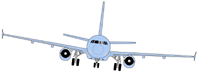
This A320 First Officer was prepared to abandon an unstable approach, but then it started to look like things might work out.
What
would you have done?
Faced with one aircraft that needed to make an emergency approach and another aircraft that presented a traffic conflict, this Air Traffic Controller had to orchestrate a solution.
As
the controller, what would you have done?
I decided that I would fly the aircraft home, because what little damage there was would not affect the airworthiness of the aircraft. When I returned the aircraft to the FBO where I had rented it they decided to send the prop off for balancing. They also removed the engine and sent it off for a mandatory tear-down and inspection. My biggest regret from this incident is that I allowed myself to explore and attempt less and less suitable landing areas to the point where I finally damaged a very nice airplane. At some point I should have set a limit for myself and not have landed a $100,000 airplane on the beach for fun. Taking off with a damaged engine and prop was also poor judgment.
I
continued toward ZZZ.... Conditions remained Marginal
VFR until 30-40 miles south of ZZZ. The weather rapidly
deteriorated and I had to be vectored around a thunderstorm.
I knew at this point that I had made a wrong decision.
I was now risking my life and was wishing I had landed
at YYY.... After discussion with Approach Control
at ZZZ and with fuel becoming a consideration, I was
vectored to an ILS approach at ZZZ. With the help
of an experienced pilot giving direction, a safe landing
was made.
I didn't take the bait. I set TOGA (Takeoff and Go Around) power and performed a go-around at 500 feet. ATC vectored us back for a normal landing. This situation showed me how easy it is to continue with an unstable approach because, when you begin to catch up with the situation, you encourage yourself to continue further and further down that unstable path which can lead to an unstable landing...or worse. I kept myself from completely falling into the trap by mentally preparing for the go-around ahead of time and not committing to the landing until stable approach parameters were met. I also believe that we sometimes accept instructions from ATC that may be difficult to perform because we don't want to cause a problem or look like we aren't good enough to handle the situation.
I declared an emergency for the Mooney as I felt time and distance were becoming critical. I descended him and it all worked out fine in the end. But the aircraft should have either indicated he was OK with being maneuvered at altitude for the traffic, or taken his own decision to descend. I felt trapped by the rules. The pilot should have been more forceful if he needed lower or been more explicit that he could wait for the traffic.
|
| ASRS Alerts Issued in May 2005 | |
|---|---|
|
Subject
of Alert
|
No. of Alerts |
|
Aircraft
or aircraft equipment
|
4 |
|
Airport
facility or procedure
|
3 |
|
ATC
procedure or equipment
|
1 |
|
Chart,
Publication, or Nav Database
|
1 |
|
Maintenance
procedure
|
4 |
|
TOTAL
|
11 |
|
May 2005 Report Intake
|
|
|---|---|
| Air Carrier/Air Taxi Pilots |
2,408
|
| General Aviation Pilots |
854
|
| Controllers |
42
|
| Cabin/Mechanics/Military/Other |
174
|
| TOTAL |
3,478
|
 Situation
#1: The propeller struck the sand and stopped the
engine."
Situation
#1: The propeller struck the sand and stopped the
engine." Situation #2: "A decision had to be made."
 Situation
#3: "I can make this."
Situation
#3: "I can make this."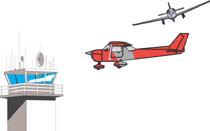 Situation
#4: "The Cessna was between him and the airport."
Situation
#4: "The Cessna was between him and the airport."