
|
The
Case of the Unstable Approach
FAA Order 8400.10
defines a stabilized approach as "maintaining a stablespeed,
descent rate, vertical flight path, and configuration during the final
stages of an approach." Significant speed and configuration changes
during an approach can complicate tasks associated with aircraft control
and increase the difficulty of evaluating an approach as it progresses.
The evidence presented in these recent ASRS reports demonstrates that
instability is no defense when an approach goes bad.
The
Hold Up
Air Traffic Controllers play an important role in the stabilized approach
concept. Appropriate vectors and traffic sequencing help ensure that
approach parameters can be met. But, as this B757 crew pointed out,
Controllers also need to be aware of the unique flight characteristics
of some aircraft.
- Approach
assigned us Runway 32L for landing and then held us up high and fast
(210 kts/6000 feet). Finally, we received approach clearance for a
visual with a turn inside the marker. We told Approach that we were
unable to accept because we could not make it down and meet company
requirements for a stabilized approach. We asked for an extended downwind
but then were told (after a handoff) that we were now cleared for
a visual to Runway 32R.... We were high and fast all the way and landed
long on Runway 32R (but on speed).... It was uncomfortable being in
a situation that didn't meet our company standards for a stabilized
approach below 1,000 feet AGL....
Lessons
learned: 1) We should have gone around and not accepted the set-up.
2) Approach facilities need to be educated about the capabilities
of [various aircraft]. Some can't get down and slow up as quickly
as others.... You have to plan ahead. 3) Recognize the importance
of a stabilized approach. [Final approach] is not the time to be changing
runways, working the FMC, configuring the aircraft, etc.
[We] called
Approach Control after landing, voiced [our] concerns about how we
were handled...and re-emphasized the importance of a stabilized approach.
The
Chase 
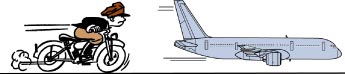
Although this Captain did manage to catch up to the aircraft and land
without incident, a clean getaway and fresh start might have been a
wiser course of action.
- [We] left
the holding pattern with vectors for the ILS to Runway 9L. The assigned
speed was 210 knots. After a change of controllers, the runway was
changed to 9R, and then changed back again to 9L with a speed of 180
knots assigned to the marker. All the Air Traffic Control (ATC) changes
with multiple radio transmissions led to a rushed environment. I got
behind the airplane and situational awareness was compromised. We
were fast at the marker and the autoflight system missed the glideslope
capture. I attempted to hand fly the ILS with the flight director
input, but the information presented was incorrect and I had to "look
through" the flight director information and fly a raw data approach....
I caught up to the aircraft at approximately 500 feet with the runway
in sight and the landing was made in the touchdown zone. The standard
operating procedure for the stabilized approach concept was violated....
The consensus of the debrief was that we should have gone around,
but no one called for it. Instead, there was a focus on, "We
can make this approach work." Additionally, there was a desire
to accommodate the Controllers who were very busy....
The
Capture
Without anticipating adjustments required for adverse conditions, a
flight crew has little chance of establishing a stabilized approach.
This CL-65 crew wisely departed the scene when the alarm went off and
managed a more successful glideslope capture the second time around.
- ATC
gave us the clearance, "Fly heading 120 degrees; maintain 2500
feet until established; 170 knots until 4 DME; cleared for the ILS
10 approach." At 2500 feet, winds were SSE at 60 knots. Due to
the shallow vector intercept and the winds aloft at the time, we did
not capture the localizer (LOC) course until inside INTXN. The glideslope
was 1/2 scale below (we were still at 2500 feet). 1500 feet was selected
on the altitude select, and a descent of 1000 fpm down was selected....
Within a few seconds, the autopilot pitched the aircraft down (over
12 degrees) to capture the glideslope. We received a "sink rate"
Ground Proximity Warning System (GPWS) message. I disconnected the
autopilot to arrest the descent rate. At this point, we were off glideslope
and straying off the LOC. I executed a missed approach at 800 feet....
We were vectored back around for another approach. Contributing factors:
1) poor awareness of winds aloft by us and the controller giving the
vectors, 2) reluctance on our part to perform a missed approach immediately
and not try to salvage the botched approach....
The
Lockup
A good approach
usually leads to a good landing. The student pilot who submitted this
report learned that the opposite is also true.
- During
my final landing to pick up [my instructor], I cut the base leg short
and did not get lined up with the runway until just over the threshold.
I had too much speed and the aircraft bounced. When I touched down
again, there was not much runway left. I locked up the brakes and
skidded off the end into some sand. All systems were shut down and
the fuel shut off. I departed the aircraft shaken but uninjured.
From
the instructor's report:
- The student
is being retrained on the importance of a proper approach, proper
airspeed control, bounced landings, braking technique, and go-arounds.
The
Escape
This MD80 crew started out
with a good approach but had to change their plans when they got hit
with a low blow.
- We were
cleared for a visual approach to Runway 24R. The First Officer was
flying. ATC cleared a B747 to land on Runway 24L and issued a caution
about wake turbulence. The First Officer was aware of the wake turbulence,
flew slightly high to stay above it, and slowed the aircraft to gain
added distance. Everything was great until 100 feet AGL where we encountered
very rapid rolls to the right then abruptly left. We initiated a go
around to escape the wake turbulence and used maximum power doing
so. We both have a great awareness of the consequences of this unseen
hazard. We did all we could to avoid it. The prevailing wind must
have blown the B747 wake directly onto our landing runway....
From
The Maintenance Desk
ASRS receives
a number of reports related to aircraft that are damaged during ground
maintenance procedures. Many of these incidents involve a failure to
activate or deactivate systems in accordance with the sequence prescribed
in the appropriate maintenance manual. The maintenance technician who
submitted this report did what he was told to do, but someone should
have checked that all related systems were set up in accordance the
maintenance manual.
- We were
getting ready to push the aircraft out for an engine idle check. I
was told to close the circuit breakers in the Electrical and Electronics
(E&E) Bay.
When I
pushed the Standby Hydraulic circuit breaker in, the pump came on
and the leading edge devices came down on the open outboard "C"
Ducts (engine cowlings). There was nobody in the cockpit at the time.
When someone went up to turn the pump off, they found the Standby
Hydraulic switch in the "Armed" position, apparently from
the B/C Check the night before. The leading edge lockout pin had already
been removed from the valve in the main wheel well.
The engine cowlings
and leading edge devices on both sides of a B737-700 were damaged in
this incident.
Tail
End Tales
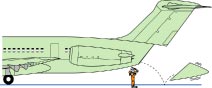
Although it might seem unlikely that anyone would confuse the MD80/90
tail cone jettison with the aft passenger door/stair operation, two
incidents reported to ASRS confirm what Mr. Murphy said, "If it
can be done wrong, it will be done wrong."
- Ramp personnel
told us that there was no passenger stair available and that they
could not fuel the aircraft with passengers on board unless an exit
door was available. Someone on the ground asked about lowering the
aft stairs. We found the procedure for exterior aft stair operation
in the aircraft manual. We gave the ramp personnel the page from the
manual. They had no questions and indicated that they could do the
procedure.... They pulled the emergency jettison handle and jettisoned
the tail cone.
- [We]
taxied to the maintenance ramp for a one-hour ATC and weather delay.
Six passengers deplaned via the aft stair because they did not wish
to continue due to the delay. The First Officer thought that you could
raise the stair from inside the cabin. I went aft and while I was
looking at the panel, the Number Two Flight Attendant, trying to help,
pulled the handle above the emergency exit door releasing the tail
cone. The tail cone fell to the ground causing some damage....
|
ASRS
Recently Issued Alerts On...
|
|
ERJ135
weight and balance incident
|
|
Unlit
taxiway at a major Western airport
|
|
B737-800
loss of F/O flight instuments
|
|
MD88
abnormal elevator control response
|
|
Questionable
baggage weight computations
|
|
 |
|
April
2003 Report Intake
|
| Air
Carrier/Air Taxi Pilots |
1,606
|
| General
Aviation Pilots |
832
|
| Controllers |
29
|
| Cabin/Mechanics/Military/Other |
154
|
| TOTAL |
2,621
|
|
|